TESTING ASSUMPTIONS: Our Problems With Authority

Part I of III

Part IA: AUTHORITY — Missing Person or Murder Case?
The end of the world as we know it bleeds endlessly through my screens and newspapers. The ‘times’ in end times is plural, so fixing one particular day as the finale is tricky and there might yet be a rescue, but some cliffhangers do result in the heroes falling off the cliff. (My friend Leo Bacica is hosting Cabaret for the End of the World at Arches Lane Theatre in London every Saturday night; Clever man who can read the room.) No force appears capable of arresting the momentum of the disintegration of peace, security, science and truth. The people that in some measure we paid to take care of this angle have proved unfailingly failingly flailingly impotent. How they qualified for these jobs confounds me. HR has a lot to answer for.
What’s missing is authority. For those recoiling at the word, please consider examining that bias. Regarding authority, many of us resemble a very picky Goldilocks; we want it not too hot, not too cold, AND with designer flavors suited to our peculiar taste. We like some kind of authority, and no matter those personal preferences shouldn’t all of us be concerned that due to the lack of a larger effective countervailing authority on the national level our world is going to hell in a hand-basket, one probably not made in the USA?
Not every kind of authority is beneficial, but no kind of authority fosters disorder under which none but the wealthiest with their security forces and private islands may prosper, The stumbles, hobblings, and outright failures of what were once taken as reliable dispensers of legitimate authority are to me both irrefutable and irremediable in that always blurry foreseeable future despite what the performative screeching of social media might convey. (I would be delighted to be proved wrong on any of this.) The next vote is November 2026. Do the math on the damage done per week since last January. Treat it as a test question: if X can corrupt and destroy this many institutions in 390 days, how many can X further degrade and disable in the next 320 days, the time between today and 2027? Extra credit for predicting the exact form of voter intimidation to be employed along the way.
Proposing passivity and resignation is not my goal here. Nor am I satisfied in just adoptiing what for some stands as the only conducive tactic in these circumstances: hoping actively that these enders of the world run out of gas or die; in the latter case peacefully, of course, a good death, as my mother would say. Instead of just waiting for the malefactors’ fuel tanks or lifespans to hit empty, examining our problems with authority could prove useful if we do survive until next year. Absent such a rethinking, we will likely end up in the same place again because it is our problems with authority that have landed us in this circumstance, a state predicted over forty years ago by , Richard Sennett’s Authority .
Why cite that book? In between ruminating on the Substacks Chasing the Dead or Testing A Personal History and praying to St. Genesius, patron saint of playwrights, that the final two-hour episode of our civilization’s End Times won’t drop until after the run of my play RETROSPECTIVE at Baron’s Court Theatre in London May 14th to May 23rd, a tower of books (that must be ‘dealt with’ according to the executive producer of the above named play, who also happens to be my wife) toppled on the office floor and Richard Sennett’s Authority slid my way. Reminded that this title word was supposed to be what kept things from falling apart. pushed the question to the forefront of my concerns and allowed postponing dealing with the rest of that pile of books. Wasn’t some form of authority supposed to foil and thwart those people ending the world? Authority — the right kind — was definitely sold to my generation as part of the deal.

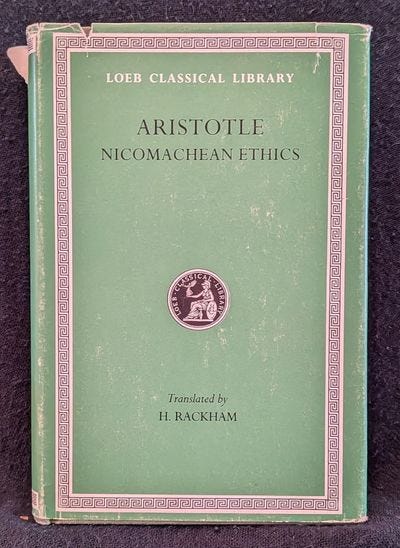
As a boomer (the cohort probably to blame for this creeping catastrophe) a feeling of responsibility to do something seized me in rereading the book and my scribbled notes from at least a decade ago in its flyleaves. Whatever happened to the centripetal authority that held the Republic together even through the Southern States war to retain slavery? That authority’s absence now appears like a missing persons case that might turn out to be a homicide, we should at least try to figure out why we let things get this bad. Is it our problems with authority that eroded the trust and effectiveness of institutions so that they now are too weak or incapacitated to stop this destruction of American society? Rackham’s translation of Aristotle’s Nicomachean Ethics has as its first sentence, “Every art and every investigation, and likewise every practical pursuit or understanding, seems to aim at some good: hence, it has been well said that the good is that at which all things aim.” The aim of this series of posts is to take aim at our problems with authority, which I believe counts as some good.
Part IB: Establishing my authority to find out what befell AUTHORITY
What gives me the authority to lead such an examination on this subject? Despite ample evidence that few on Substack ever feel a need to justify their writings, I’ll answer the question. My roots of expertise in authority appear simultaneously obvious and obscure. Like the fish not seeing water or the polar bear not feeling cold, as Japanese Count Tadasu Hayashi once wrote. I did “not even think that anything which has been happening daily in (my) own immediate surroundings ever since their infancy can possibly be worthy of notice”. Not until comparisons with the environments of friends occurred did the paradox in which my siblings and I lived become evident. My schoolmates enjoyed a diluted or even absent atmosphere of command and power along with a reverence for the powers that be. We Elliotts were the opposite: the unusual strictness of the disciplinarian culture inside our home coexisted with a skepticism by our potentate — my father — for all other forms of authority. We adopted that attitude as a sort of ‘four legs good, two legs bad’ device to simplify things, skeptical of all authority except our own.
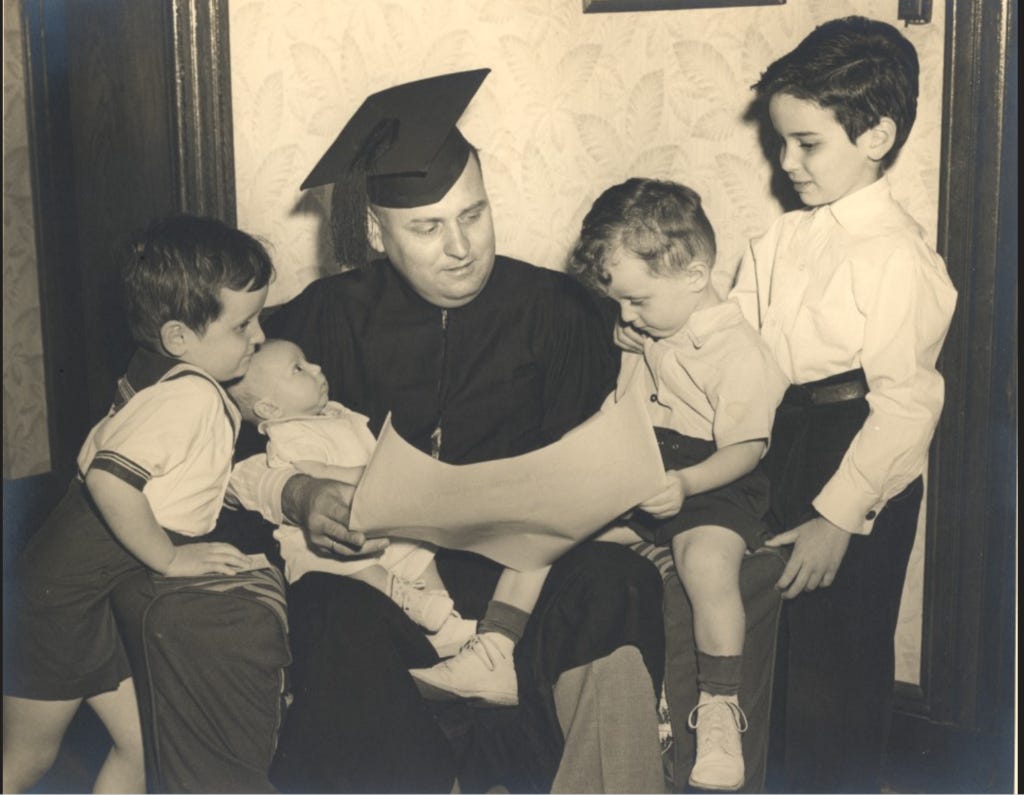
This absolutism put us against the world, but never (outwardly, at least) against our father. Therefore, this experience made me an expert on authority.
Not.
Or maybe.
Depends if you accept my other credentials or if you even believe in credentials, those proofs of knowledge and skill. This is where our problems with authority begin: doubts in the pertinence or even existence of credentials are prime suspects in the disappearance of authority. Self-assertions of proficiency should be suspect, but rejection of all claims leaves us without guidance or insight into critical areas. We all know something of authority; whether dispensing or receiving. For me from that taut-ship home through the nuns who ranged from stern to sadistic to Jesuits who let their minds do the manipulating, my youth was soaked in authority. But in 1978 at the age of 26. Doctor Sam Mastrianni made me the Executive Director of the Saratoga County Drug Agency in upstate New York, an organization on ‘double secret probation’ at the time from the State agency. Two years earlier, I was a teacher in a reform school, where authority comes in a variety of flavors. Mine was kind of French vanilla. Immediately before this promotion, I was an alcoholism counselor for the Mental Health department in the county, setting diagnoses and prescribing treatment regimens. Were they always followed? No. My clients were after all alcoholics. Were they always correct? Hell, no. Ascending to that job, I was after all twenty-four years old. Suddenly people worked for me. I promulgated policies and declared events. We escaped probation and avoided extinction. Authority? I was hip deep in the stuff. My primary learnings then about authority were:
Knowledge mattered; As T.S.Eliot advised, “There is no method but to be very intelligent.”
Back up your decisions with solid facts and careful decisions.
A little goes a long way. If you must get drunk, make it on a beverage and not power..
Twenty-five years later, hobnobbing with powerful CEO’s and other C-Suite personages as a consultant and then Chief Learning Officer afforded me a front row seat on authority. No, It was more like an airplane jump seat where you’re next to the pilot and trying not to show your nerves. I saw large-scale authority in action. Decisions were made, often with my facilitation, that turned into orders and ultimatums for thousands of people not in the room where it happened. Most of them couldn’t even find the room, which candidly. tended to the tacky techno side with the scent of competition, mostly male, embedded in the knock-off designer leather chairs.

These experiences showed me how authority happens and mishappens. My learnings from that first Executive Director job seemed less relevant. Tracing authority’s evolution in some organizations was easy after a while; A newcomer elbows existing bosses out of the way, boxes out rivals, scores point after point in never ending sessions spawning simulacrums of strategy.
(Or is the plural simulacra because of the word’s Latin roots? Not claiming authority in that area, but I did have three years of high school Latin in the 1960s.) Simulacrums are things that “merely have the form or appearance of a certain entity without possessing its substance or proper qualities”. Many of the strategies produced fit that particular shoe. There is another OED meaning for simulacrum — a mere image or specious imitation or likeness of something, But that’s probably too harsh a judgment of those strategies.; After all, I facilitated those sessions and was reputed to be something of an expert on facilitation and large group decision-making. Back then expertise, prowess, adeptness, wizardry still conveyed some but not likely the highest authority in our best of all DoorDash worlds.
Part IC: What constitutes authority?
This is where one end of the problem starts: the assumption of authority by self-proclaimed experts. In that manner, gradually a society loses a ‘cultural coherence‘ as to what constitutes authority. The Romans had that cultural coherence about auctoritas according to Volume one of the five volume set Dictionary of the History of Ideas. That first volume covered Abstraction to Design Argument. The entry on Authority spanning pages 141 to 162 marked my furthest progress in that volume. Leanard Krieger authored the analysis and as his NYT obituary documented he boasted what for most of the last 100 years were considered top tier sources of authority: Rutgers, Yale, Harvard, U. Chicago, Columbia. In his entry on authority, Leonard points out that authority is chameleonic; indeed, his first sentences state that “The idea of authority has no single historical definition. Originally, its dominant meaning was the capacity to evoke voluntary compliance or assent, on grounds distinct from coercive power or rational conviction.”
There it is: Krieger gives us a big clue why authority as a bulwark against the demolition of institutions is missing in action. The capacity to evoke voluntary compliance has withered away. Everything is up for grabs. Science? Journalism? Religion? Government? The Courts? We’re skeptical of the other side including the side in the middle that doesn’t want to take sides. And when we have done with the internecine ‘you’re not the boss of me’ scolding and cursing then we turn skeptical intraculturally imposing sanctions and purity tests in those who mostly agree with us. True safety-net authority for a republic requires large-scale agreement.
No idealized notions are imputed in citing Rome as an example of a usefully organized authority; a deeply hierarchical society with slaves is not to be emulated. But as Krieger notes, in Rome for hundreds of years “the correlative of authority was trust“, and that part deserves imitation. Krieger in that entry quotes Mommsen who wrote of
auctoritas that it was ”more than a counsel and less than a command; rather a counsel with which one could not properly avoid compliance.” Think of the Republican Senators going to Nixon in 1974 and telling him the jig was up, which led to his voluntary resignation. Krieger continued ”the Senate’s Authority was attributed to the actual binding force of its counsels.” There had to be agreement on the reality and importance of that binding force or the whole structure shattered as it would eventually even before Caesar’s actions. We are left with the play acting of authority. And proposing further how that came about will take us back to Richard Sennett’s book in Part 2 of this test of assumptions.
